
Fear Became My Super Power
Fear used to run my life. Not always loudly. Sometimes it looked like control, perfectionism, people pleasing, performance, avoidance, anger, isolation, or addiction.
I spent years trying to escape fear. I used lust, fantasy, distraction, validation, substances, ego, and control trying to avoid discomfort.
What recovery slowly taught me was this: fear itself was never really the enemy. Running from fear was.
Once we stop organizing our lives around avoiding pain, fear starts becoming something else entirely. It becomes a doorway into growth. Into honesty. Into surrender. Into freedom.
"The places I feared the most were often the exact places recovery needed me to grow."
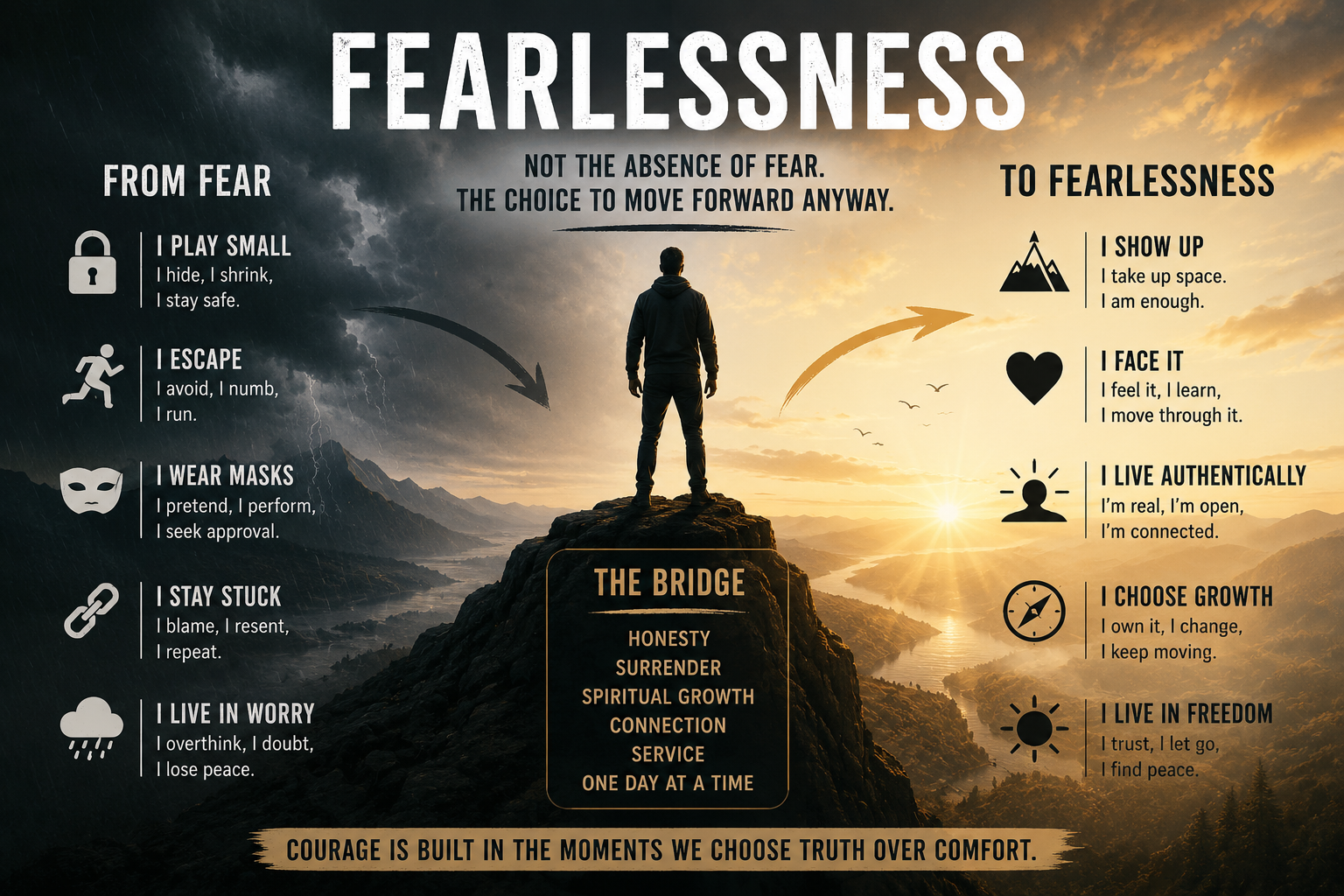
"Recovery did not remove fear from my life. It taught me how to stop running from it."
Fear Controlled More Than I Realized
Most addicts are not fearless when they arrive in recovery. Most of us are terrified underneath the surface.
Fear of rejection. Fear of failure. Fear of abandonment. Fear of vulnerability. Fear of intimacy. Fear of not being enough. Fear of being exposed. Fear of life itself.
A lot of addiction is built around escaping those fears.
- People pleasing
- Controlling outcomes
- Performing for approval
- Escaping through lust or substances
- Staying emotionally unavailable
- Avoiding difficult conversations
- Living behind masks
"A lot of my addiction was not about pleasure. It was about escape."
Fear kept many of us disconnected from ourselves, from God, and from other people.
The Bridge Between Fear and Freedom
The bridge from fear to fearlessness is not built through hype, ego, or pretending. It is built through ordinary recovery actions practiced consistently.
Honesty
Secrets feed fear. Truth weakens it.
Surrender
We stop trying to control everything through self-will alone.
Connection
Fear grows in isolation. Healing grows in community.
Spiritual Growth
Prayer and recovery help us stay grounded instead of reactive.
None of these are flashy. But they change lives. Slowly. Honestly. One day at a time.
What Fearlessness Actually Looks Like
Fearlessness in recovery is usually quieter than people expect.
It does not look like domination. It does not look like pretending nothing hurts. And it definitely does not look like becoming emotionally numb.
Fearlessness In Recovery
- Calling your sponsor instead of isolating
- Admitting relapse honestly
- Walking into meetings ashamed but willing
- Telling the truth faster
- Taking inventory instead of blaming
- Asking for help instead of pretending
Fearlessness In Life
- Having difficult conversations
- Setting healthy boundaries
- Trying again after failure
- Being emotionally available
- Letting people really know you
- Choosing growth over comfort
"Fearlessness is not becoming untouchable. It is becoming willing."
What Keeps Us Stuck
One of the hardest truths in recovery is realizing fear itself is usually not what destroys us. What destroys us is the life we build trying to avoid fear.
Avoiding vulnerability. Avoiding rejection. Avoiding accountability. Avoiding grief. Avoiding honesty. Avoiding discomfort.
Eventually our entire world shrinks around avoidance patterns.
What Fear Says
- "Stay hidden."
- "Control everything."
- "Do not trust anyone."
- "Do not risk failure."
- "Escape discomfort immediately."
What Recovery Says
- Truth creates freedom
- Connection heals isolation
- Growth requires discomfort
- Help is not weakness
- Fear does not have to run your life anymore
"My life started changing when I stopped waiting to feel safe before becoming honest."
Recovery Slowly Gives Us Our Life Back
Recovery does not magically remove fear overnight. But it changes our relationship with it.
We become more grounded. More honest. More connected. More willing. More alive. Not because we become fearless superheroes. But because we slowly stop worshipping fear.
We learn that rejection is survivable. Mistakes are survivable. Feelings are survivable. Vulnerability is survivable. Life itself becomes survivable.
I'm still learning this. Fear still stops me from action sometimes. But taking the actions that support the truth I can lean in instead of running away. Without fear? Nope, but through it, not by myself but with the support I need to stand up in it and walk through. There is always the other side of fear and it's filled with light.
"Recovery did not make me fearless. It made me willing to live anyway."
And honestly, that kind of courage changes everything.
If fear, addiction, isolation, or hopelessness feel overwhelming right now, please reach out to someone safe. You do not have to carry it alone.
988 Suicide & Crisis Lifeline: Call or text 988 (24/7 U.S.)
Emergency: Call 911 if you are in immediate danger.
SAMHSA National Helpline: 1-800-662-4357
National Drug Helpline: 1-844-289-0879
Connection interrupts isolation. Honesty interrupts fear. Help is available.