
Humility in Recovery and Life
Humility is one of those recovery words that gets misunderstood constantly. Some people hear humility and think weakness. Others think shame. Others think becoming small, passive, quiet, invisible, or pretending they are worthless. That is not humility. Not even close.
Real humility is seeing reality clearly. It is knowing who you are and who you are not. It is being teachable. Honest. Grounded. Responsible. It is accepting limits without collapsing into self-hatred and accepting strengths without turning them into ego fuel.
"Humility is not thinking less of yourself. It is thinking about yourself less."

A lot of us came into recovery with massive ego problems and almost no real self-worth. Which is a weird combination until you experience it. We wanted control, validation, certainty, attention, escape, admiration, comfort, and relief. At the same time, a lot of us secretly hated ourselves.
That is part of why humility matters so much in recovery. Without it, we either inflate ourselves or collapse into ourselves. Both usually end badly.
"Ego says, ‘I already know.’ Humility says, ‘Maybe I need help.’"
What Humility Actually Is
Humility is not humiliation. It is not pretending to be weak. It is not becoming a doormat. And it is definitely not hating yourself in a spiritual tone of voice.
Humility is reality.
- Seeing yourself honestly
- Being willing to learn
- Accepting correction without imploding
- Knowing you are not the center of the universe
- Taking responsibility without drowning in shame
- Understanding you need other people and a Higher Power
Humility allows growth because humility allows honesty.
Without humility, every conversation becomes self-protection. Every mistake becomes a threat. Every suggestion feels offensive. Every disagreement feels personal.
"Relieve me of the bondage of self."
Humility Lives Between Ego Inflation and Ego Collapse
A lot of addicts swing between two extremes: feeling bigger than everyone else or feeling smaller than everyone else. One side inflates the ego. The other crushes it. But both keep us trapped in self-obsession.
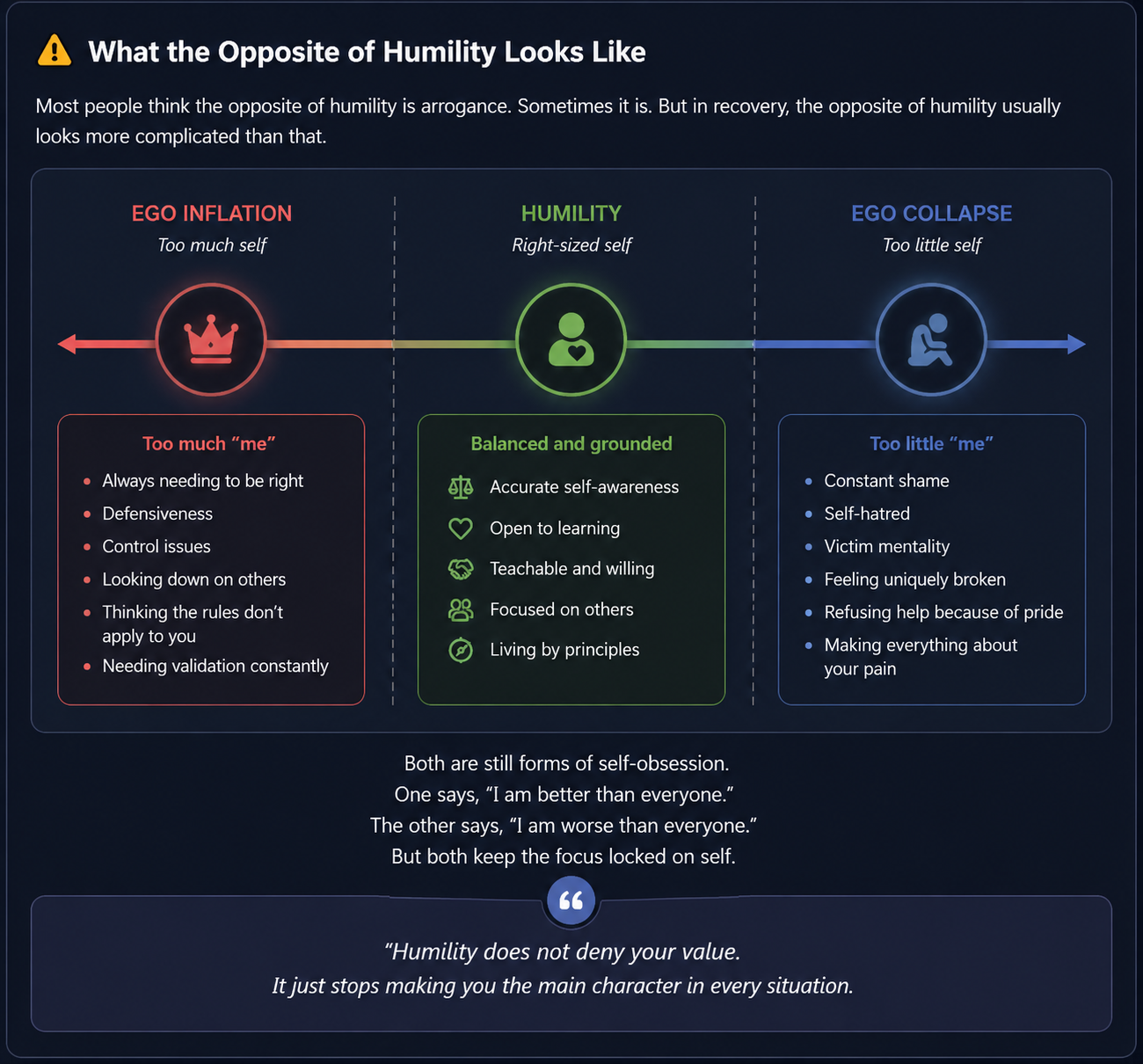
Humility allows us to accept reality without turning ourselves into either gods or garbage. It lets us take responsibility without drowning in shame. It helps us stay open, willing, and connected.
"Humility is not thinking less of yourself. It is seeing yourself clearly enough that you no longer have to constantly defend or perform."
What Humility Looks Like for Addicts
For addicts, humility often starts with surrender. Not theoretical surrender. Actual surrender.
Admitting we cannot think, manipulate, isolate, fantasy, hustle, or self-will our way into lasting peace.
That is brutal for people who spent years trying to control everything.
- Calling a sponsor when you do not want to
- Admitting you were wrong
- Going to meetings consistently
- Listening instead of performing
- Being honest about relapse triggers
- Taking feedback without turning it into a courtroom trial
- Accepting that recovery is not about looking spiritual
Humility usually feels uncomfortable at first because it strips away image management.
A lot of us spent years trying to appear okay instead of actually becoming okay.
"Recovery started getting better when I stopped trying to look recovered."
What Humility Looks Like in Relationships
Humility changes how we treat people.
Instead of controlling conversations, we start listening. Instead of defending every mistake, we start owning them. Instead of demanding understanding, we start practicing understanding.
- Apologizing without excuses
- Letting people have feelings about your actions
- Not needing to win every disagreement
- Being teachable
- Asking questions instead of assuming
- Serving instead of performing
Humility creates connection because humility makes honesty safer.
How to Practice Humility Daily
Humility is not just an idea. It is something we practice. Usually badly at first.
Listen More
- Stop preparing your defense while others talk
- Actually hear feedback
- Let people finish speaking
Admit When You Are Wrong
- Without excuses
- Without turning it into self-hatred
- Without manipulating sympathy
Stay Teachable
- Read recovery literature
- Talk to people with experience
- Accept that you do not know everything
Practice Service
- Help without needing attention
- Do small things consistently
- Get out of self
Humility grows through action. Not image. Not performance. Not spiritual vocabulary.
What Changed for Me
I used to think humility meant feeling bad about myself. Honestly, I was already doing plenty of that.
What I eventually learned is that humility is much calmer than ego. It does not need to dominate every room. It does not need constant reassurance. It does not panic every time somebody disagrees.
Humility helped me stop performing recovery and start participating in it.
It helped me become more honest. More teachable. Less reactive. Less exhausting to live inside my own head.
"Humility gave me permission to stop pretending."
And honestly, some days I still struggle with it. Some days my ego wants attention. Some days it wants control. Some days it wants to be right more than it wants peace.
But recovery keeps teaching me the same thing over and over: peace usually grows where ego finally loosens its grip.
If things feel heavy or out of control, you do not have to carry it by yourself.
If you are in immediate distress, call or text 988 to reach the Suicide & Crisis Lifeline. It is free, confidential, and available 24/7.
SAMHSA National Helpline: 1-800-662-4357
National Drug Helpline: 1-844-289-0879
If you or someone else is in immediate danger, call 911.
Reach out to your sponsor, someone in recovery, or someone safe. Isolation and pride keep people sick. Connection helps people heal.